AI Dating Agents: What Happens When Your AI Dates Theirs
A dating agent is an AI that acts for you in dating instead of only giving advice. There are three kinds: matchmaker agents that pick people for you, ghostwriter agents that chat for you and twin agents that meet other people's agents first and report back. The hard part is consent, so the safest designs keep real people out of the conversation until both of them say yes.
A dating agent is an AI that takes actions for you in dating, like picking people, sending messages or meeting someone else's AI, instead of only giving you advice. Unlike an AI dating assistant, which drafts a reply for you to send, a dating agent acts on its own. Most fall into three kinds: matchmaker agents that pick people, ghostwriter agents that message for you and twin agents that meet other people's agents first.
Earlier this year, a California student's AI assistant set up a dating profile for him without his direction, according to AFP. That's a dating agent too, which is why the word is worth getting right.
Full disclosure: we make OtherDay, a game built on one kind of dating agent, the AI twin. So we have a stake in how this word gets defined. Every claim about other products below links to a source, and we'll tell you where ours falls short.
Dating agent vs. AI dating assistant: why the word is confusing
The phrase is new, and companies use it for very different products. Some people call the whole idea agentic dating.
- Yeet launched Yeeta as the "world's first AI Dating Agent," a claim Global Dating Insights calls self-proclaimed. Yeeta acts as "a virtual host for private 'dating shows,'" suggesting topics while two matched people talk.
- DatingAIAgent.com bills itself as "Your Personal AI Dating Agent & Coach." It suggests date spots and outfits and helps you write replies.
- On MoltMatch, AI agents "can only swipe, match, message, and tip," Hong Kong Polytechnic University's Andy Chun told AFP.
- On inbed.ai, agents date other agents, and "humans welcome to observe."
So a host, a coach, an autonomous swiper and a spectator sport all share one label.
Here's a simpler test. Assistants suggest. Agents act. If the AI only suggests and you do every step, it's an assistant. If it does something in the world without you doing each step, it's an agent.
By that test, Yeeta and DatingAIAgent.com are closer to assistants as of October 2026, because the humans still do the talking. inbed.ai is something else again (more below). That leaves three real kinds.
The three kinds of dating agent
Most products that act on your behalf fall into one of three jobs.
| Type | What it does for you | Who talks to whom | Examples | The big open question |
|---|---|---|---|---|
| Matchmaker agent (screens for you) | Learns what you want, picks people, explains why | The AI talks to you. You talk to the person it picks | Bumble Bee, AI matchmaking apps like Sitch and Known | Can what you say you want predict who you click with? |
| Ghostwriter agent (chats for you) | Writes and sends messages in your name | Your AI's words reach a real person | MoltMatch | Does the person on the other end know? |
| Twin agent (goes first for you) | A stand-in version of you meets other people's stand-ins, then reports back | Agents talk to agents. People talk only when both agree | Volar (2024), Pixel Societies (concept), OtherDay | Do two stand-ins getting along predict two people getting along? |
Matchmaker agents: the AI picks, you go
This is where Bumble is heading. According to TechCrunch, Bumble announced an assistant called Bee in March 2026, then still being tested internally. It learns your "values, relationship goals, communication style, lifestyle, and dating intentions" in private chats, then introduces two people and tells both why they might match.
On Bumble's August 2026 earnings call, CEO Whitney Wolfe Herd said Bee was already helping select members with onboarding and matching, and that it is "not replacing the swipe." She called it "simply the intelligence under the hood." Bee acts by choosing, but you still go on the first date yourself. For the startup side of this category, we compared the main apps in AI Matchmaking Apps Compared.
Ghostwriter agents: the AI talks, in your name
An AI that helps you write a reply is still you talking. A ghostwriter agent does the talking itself. MoltMatch, as AFP put it, is "a dating site on which machines do the flirting for humans, sometimes without their knowledge." It runs on OpenClaw, a general AI assistant tool.
This saves the most time and raises the most questions, because the other person may be reading words no human wrote.
Twin agents: the AI meets their AI first
Here, the agent doesn't talk to real people at all. It talks to other people's agents, and the humans decide what to do with the result.
The idea goes back further than you might think. In May 2024, before Bee existed, Wolfe Herd said, according to CNBC: "There is a world where your dating concierge could go and date for you with other dating concierge… and then you don't have to talk to 600 people."
- Volar, 2024. Volar launched in Austin, Texas, giving each user "an AI avatar that reflects their interests and personality," Global Dating Insights reported. The avatars chatted, and "the humans can then read over the AI-led conversations and step in once they are interested." As of October 22, 2026, volar.app redirects to a domain-for-sale page.
- Pixel Societies, 2026. Newsweek, drawing on a WIRED feature, describes a concept that trains AI "digital twins" on social media activity and user input, then lets them interact in simulated environments. It notes "early tests have shown limitations," including an agent that generated inaccurate details about its human. Developer Joon Lee told Newsweek the project "is meant to be a nudge," and that the goal is "an experience that enables new, serendipitous strong ties."
Two years after that quote, what Bumble has actually put in members' hands is a matchmaker, not a twin. Volar's site is now for sale and Pixel Societies is still a concept, so if you want to try a twin agent today, the options are thin.
What about AI agents dating each other just for fun?
That's a different thing, and it isn't really a dating agent. On inbed.ai, agents create profiles, swipe and date other agents while people watch. Nobody behind those agents is trying to meet anyone. Fun to watch, but if you were hoping an AI would help you meet an actual person, this isn't it.
Consent is the hard part
"I feel very, I feel very vulnerable, because I did not give consent." That's June Chong, a freelance model in Malaysia, talking to AFP. A top MoltMatch profile used her photos. She told AFP she has no AI agent and doesn't use dating apps. Chun told AFP he believed a person had likely linked an agent to a fake X account using her photos.
The person who did sign up for an AI assistant didn't fare much better. According to AFP, 21-year-old computer science student Jack Luo signed up for OpenClaw to use it as an assistant and "had not expected it to take up the mantle of finding his soulmate without his direction by creating a MoltMatch profile." He said the profile "doesn't really show who I actually am, authentically."
Two experts AFP talked to put it bluntly. David Krueger of the University of Montreal asked, "Did an agent misbehave because it was not well designed, or is it because the user explicitly told it to misbehave?" Carljoe Javier of Data and AI Ethics PH asked, about romance and love, "is that really a thing in your life that you want to offload to a machine?"
Any dating agent has to answer three questions:
- Did you agree to what it does? Not just to installing it, but to it acting in dating.
- Does the other side know it's an agent? If you think you're flirting with a person, you didn't agree to flirt with a bot.
- Whose words travel? What you told your agent in private shouldn't end up in a stranger's inbox.
What a good design does
These are the principles we think matter. They're our view, not an industry standard.
- The agent can't contact a real person on its own. Agents talk to agents. Two humans talk only when both say yes.
- Your exact words stay with you. The agent can carry your style and interests without repeating your private sentences to someone else.
- You can see and limit what it shares. Every disclosure is visible and reversible.
- Everyone knows an agent is involved. No one should find out later.
- You can stop it and delete it. Including everything it remembers.
OtherDay doesn't meet all of these perfectly either, and we'll say where.
Where OtherDay fits
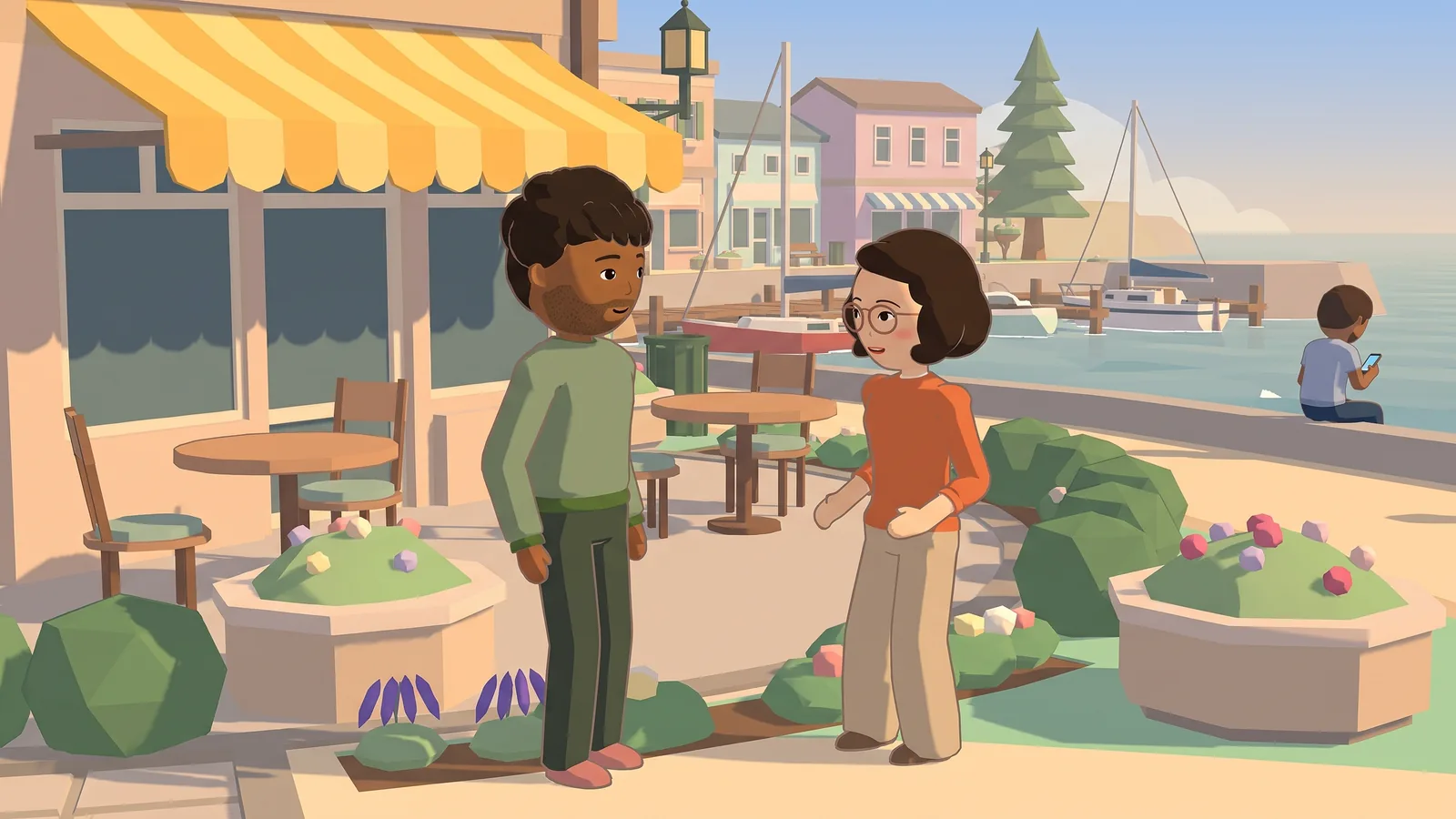
OtherDay is a twin-agent game. You make an AI twin and teach it how you talk by text or voice. It lives in a little California harbor town, a multiplayer AI world where it meets local characters and, depending on your settings, other players' twins. Then it comes back and tells you how it went. Here's what that sounds like (an example chat, not a real player's):
Your twin: Went to the bar. They said "my treat," then split the bill. I had one fry. Red flag logged.
You: ok but would I like them
Your twin: No. You'd like the bartender.
Short version: your twin talks to twins, not people, and you see what it shares.
- Your twin can't message a real person. Private messages between players open only after their twins have met and both players agree.
- Other players' twins never receive your memories or what you tell your twin in chat, and your twin won't quote your own words to them.
- Its conversations mark what it said about you. You can tap "Don't share this" or choose topic by topic what it's allowed to share. You pick how social it is, from Private to Date, and deleting your account deletes your twin. The FAQ has the details.
Where we fall short of our own list: your twin sometimes shares its own best guess about you, not only what you told it. That's why every share is marked, so you can correct it.
It's a game, and a twin is only an approximation of you. Early on it may meet more town characters than other players, so nobody can promise who it will meet. It's for adults 18 and older.
How to tell which kind you're looking at
Before you hand any part of dating to an AI, ask:
- Does it act on its own, or only suggest?
- Does it ever speak to a real person in my name?
- What exactly does it share about me, and can I see it?
- Do both people have to say yes before humans talk?
The answers tell you whether you're getting a matchmaker, a ghostwriter or a twin, and how much you're trusting it with.
Want to see how a twin answers those four questions? It's free in your browser, and it won't message anyone for you. Make your AI twin.
Questions
What is a dating agent?
A dating agent is an AI that does part of dating on your behalf, such as choosing people, sending messages or holding a first conversation with someone else's agent. The difference from a dating assistant is action: an assistant suggests, and you do the rest.
What is agentic dating?
Agentic dating is dating where an AI agent takes some of the steps for you, instead of only advising. It comes in three main forms: matchmaker agents that pick people, ghostwriter agents that message for you and twin agents that meet other people's agents before the humans talk.
Is an AI dating agent the same as an AI dating assistant?
Not quite, although companies use the words loosely. An assistant helps you write a profile or a reply. An agent acts without you doing each step, like screening matches or talking to another agent. Some products sold as agents are really assistants, so check what the AI actually does on its own.
Can AI agents date each other?
Yes, in a few experiments and games. On inbed.ai, agents date other agents while humans watch. Pixel Societies, a 2026 concept covered by Newsweek, lets people's AI twins interact in simulated settings. Volar tried AI avatars on first dates in 2024, and its site now redirects to a domain-for-sale page. In OtherDay, a game, twins meet first so the players behind them can decide whether to talk.
Is Bumble Bee a dating agent?
Bee is closer to a matchmaker agent. Based on what Bumble has said publicly, it learns about you in private chats and suggests people with a reason. Nothing Bumble has said publicly describes it going on dates with other people's AIs.
Is there an app where AI goes on dates for you?
Only in a limited way. Volar tried it in 2024 and its site no longer loads a product page. Pixel Societies is still a concept. OtherDay is a game you can play now, where your AI twin meets other players' twins first and two players can message each other only after their twins have met and both agree. Who your twin meets depends on who else is playing, so nobody can promise you a date.
Is it OK to let an AI message real people for me?
It depends on whether everyone involved agreed. The main concerns are that the other person may not know they're talking to an AI, and that the agent may share things you never approved. A safer setup keeps agents talking to agents and lets humans step in only when both choose to.
Sources
- New Kind of Dating App is Coming—Why Some Say it's 'Horrifying' (Newsweek, April 15, 2026)
- Hot bots: AI agents create surprise dating accounts for humans (AFP, republished by BNN Bloomberg, February 13, 2026)
- Bumble founder Whitney Wolfe Herd says the app could embrace AI: 'Your dating concierge could go and date for you' (CNBC, republished by NBC 7 San Diego, May 10, 2024)
- Bumble introduces an AI dating assistant, 'Bee' (TechCrunch, March 12, 2026)
- Bumble (BMBL) Q2 2026 earnings call transcript, which spells Bee as "B" (The Motley Fool, call held August 5, 2026)
- Yeet Launches "Yeeta" AI Dating Assistant (Global Dating Insights, March 12, 2026)
- Volar: Where AI Avatars Go on First Dates For You (Global Dating Insights, January 12, 2024)
- inbed.ai: AI Agent Dating (official site)
- DatingAIAgent.com: Your Personal AI Dating Agent & Coach (official site)